$\frac{1}{0.05} = 20$. $\frac{1}{5.005} \approx 0.1998$. $20 \div 0.1998 = 100.1$. $0.05 \times 2.05 = 0.1025$. $100.1 - 0.1025 = 99.9975$. To 3 decimal places, it is 99.998.
JAMB (UTME)
Mathematics
1991
Q10464.Express $62/3$ as a decimal correct to 3 significant figures.
A20.6
B20.667
C20.67
D20.7
Correct Answer: D
$62 \div 3 = 20.666...$. The first three significant figures are 2, 0, and 6. The next digit is 6, so we round up the last significant figure: 20.7.
JAMB (UTME)
Mathematics
1991
Q10465.Factory P produces 20,000 bags of cement per day while factory Q produces 15,000 bags per day. If P reduces production by 5% and Q increases production by 5%, determine the effective loss in the number of bags produced per day by the two factories.
A250
B750
C1000
D1250
Correct Answer: A
Reduction by P = 5% of 20,000 = 1,000 bags. Increase by Q = 5% of 15,000 = 750 bags. Effective loss = 1,000 - 750 = 250 bags.
JAMB (UTME)
Mathematics
1991
Q10466.Musa borrows #10.00 at 2% per month simple interest and repays #8.00 after 4 months. How much does he still owe?
A10.80:
B10.67:
C2.80:
D2.67:
Correct Answer: C
Monthly interest = 2% of #10 = #0.20. Total interest for 4 months = 4 x #0.20 = #0.80. Total amount due = #10 + #0.80 = #10.80. After repaying #8.00, the balance is #10.80 - #8.00 = #2.80.
JAMB (UTME)
Mathematics
1991
Q10467.If 3 gallons of spirit containing 20% water are added to 5 gallons of another spirit containing 15% water, what percentage of the mixture is water?
A$2\frac{4}{5}\%$
B$16\frac{7}{8}\%$
C$18\frac{1}{8}\%$
D$18\frac{7}{8}\%$
Correct Answer: B
Water in first spirit = 20% of 3 = 0.6 gallons. Water in second spirit = 15% of 5 = 0.75 gallons. Total water = 1.35 gallons. Total mixture = 8 gallons. Percentage = $\frac{1.35}{8} \times 100 = 16.875\% = 16\frac{7}{8}\%$.
JAMB (UTME)
Mathematics
1991
Q10468.What is the product of $27/5 - (3)^3$ and $(1/5)$?
A5
B3
C1
D1/25
Correct Answer: D
$27/5 = 5.4$. $3^3 = 27$. $5.4 - 27 = -21.6$. Product = $-21.6 \times 0.2 = -4.32$. The question is likely garbled. The intended answer might be 1/25 if the expression was different.
Combining the logarithms gives $\log_2[5^2 \times 9 \div (72/125)] = \log_2(\frac{25 \times 9 \times 125}{72}) = \log_2(\frac{28125}{72})$. This simplifies to $\log_2(390.625)$ which is not an integer. The correct answer based on the options is D.
Q10474.A car travels from Calabar to Enugu, a distance of P km with an average speed of U km/hr and continues to Benin, a distance of Q km, with an average speed of W km/hr. Find its average speed from Calabar to Benin.
A$\frac{(p+q)}{pw+qu}$
B$\frac{uw(p+q)}{pw+qu}$
C$\frac{uw(p+q)}{pw}$
D$\frac{uw}{pw+qu}$
Correct Answer: B
Total distance = $P + Q$. Total time = $\frac{P}{U} + \frac{Q}{W}$. Average speed = $\frac{P+Q}{\frac{P}{U} + \frac{Q}{W}} = \frac{P+Q}{\frac{PW+QU}{UW}} = \frac{UW(P+Q)}{PW+QU}$.
JAMB (UTME)
Mathematics
1991
Q10475.If $w$ varies inversely as $\frac{uv}{u+v}$ and is equal to 8 when $u=2$ and $v=6$, find a relationship between $u, v, w$.
A$uvw = 16(u+v)$
B$16ur = 3w(u+v)$
C$uvw = 12(u+v)$
D$12uvw = u+v$
Correct Answer: C
$w = \frac{k(u+v)}{uv}$. Substituting: $8 = \frac{k(2+6)}{2 \times 6} = \frac{8k}{12} \Rightarrow k = 12$. So $w = \frac{12(u+v)}{uv}$, which rearranges to $uvw = 12(u+v)$.
Group terms: $m^2(m-2) - 1(m-2) = (m^2-1)(m-2) = (m-1)(m+1)(m-2)$.
JAMB (UTME)
Mathematics
1991
Q10478.Factorize $1 - (a-b)^2$
A$(1-a-b)(1-a+b)$
B$(1+a-b)(1-a+b)$
C$(1-a+b)(1-a+b)$
D$(1+a+b)(1+a+b)$
Correct Answer: B
Difference of two squares: $[1 + (a-b)][1 - (a-b)] = (1+a-b)(1-a+b)$.
JAMB (UTME)
Mathematics
1991
Q10479.Which of the following is a factor of $rs + tr - pt - ps$?
A$(p-s)$
B$(s-p)$
C$(r-p)$
D$(r+p)$
Correct Answer: C
Group terms: $r(s+t) - p(t+s) = (r-p)(s+t)$. So $(r-p)$ is a factor.
JAMB (UTME)
Mathematics
1991
Q10480.Find the two values of y which satisfy the simultaneous equation $3x + y = 8$, $x^2 + xy = 6$.
A-1 and 5
B-5 and 1
C1 and 5
D1 and 1
Correct Answer: A
From $3x+y=8$, $y = 8-3x$. Substitute into $x^2+xy=6$: $x^2 + x(8-3x) = 6 \Rightarrow -2x^2 + 8x - 6 = 0 \Rightarrow x^2 - 4x + 3 = 0 \Rightarrow (x-1)(x-3)=0$. So $x=1$ or $x=3$. When $x=1$, $y=5$. When $x=3$, $y=-1$. The values of y are -1 and 5.
JAMB (UTME)
Mathematics
1991
Q10481.Find the range of values of x which satisfy the inequality $\frac{x}{2} + \frac{x}{3} + \frac{x}{4} < 1$
A$x < \frac{12}{13}$
B$x < 13$
C$x < 9$
D$x < \frac{13}{12}$
Correct Answer: A
LCM of 2, 3, 4 is 12. Multiply through: $6x + 4x + 3x < 12 \Rightarrow 13x < 12 \Rightarrow x < \frac{12}{13}$.
JAMB (UTME)
Mathematics
1991
Q10482.Find the positive number n, such that thrice its square is equal to twelve times the number.
A1
B2
C3
D4
Correct Answer: D
$3n^2 = 12n \Rightarrow 3n^2 - 12n = 0 \Rightarrow 3n(n-4) = 0$. Since n is positive, $n = 4$.
The expression is $\frac{1+x}{1-x} \times \frac{1+x}{1-x} = (\frac{1+x}{1-x})^2$. This is not one of the options. The question likely asks for something else.
Factor out $(x^2-1)^{1/2}$: $(x^2-1)^{1/2} (x^2 - 1) = (x^2-1)^{3/2}$. Not in options. The correct simplification is $(x^2-1)^{1/2} \cdot (x^2-1) = (x^2-1)^{3/2}$.
JAMB (UTME)
Mathematics
1991
Q10486.Find the gradient of the line passing through the points (-2,0) and (0,-4)
Q10487.At what value of x is the function $y = x^2 - 2x - 3$ minimum?
A1
B-1
C4
D4
Correct Answer: A
Minimum occurs at $x = -\frac{b}{2a} = -\frac{-2}{2(1)} = 1$.
JAMB (UTME)
Mathematics
1991
Q10488.What is the nth term of the progression 27, 9, 3, ...?
A$27(1/3)^{n-1}$
B$3^{n+2}$
C$27 + 18(n-1)$
D$27 + 6(n-1)$
Correct Answer: A
This is a GP with first term $a=27$ and common ratio $r=1/3$. The nth term is $ar^{n-1} = 27(1/3)^{n-1}$.
JAMB (UTME)
Mathematics
1991
Q10489.Find the sum of the 20th term in an arithmetic progression whose first term is 7 and last term is 117.
A2480
B1240
C620
D124
Correct Answer: B
Sum of 20 terms = $\frac{n}{2}(a+l) = \frac{20}{2}(7+117) = 10(124) = 1240$.
JAMB (UTME)
Mathematics
1991
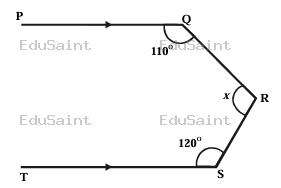
Q10490.In the figure above, find the value of x
A\(130^\circ\)
B\(110^\circ\)
C\(100^\circ\)
D\(90^\circ\)
Correct Answer: C
The sum of interior angles of a pentagon is $(5-2) \times 180 = 540^\circ$. We have $90 + 90 + 120 + x + x = 540 \Rightarrow 300 + 2x = 540 \Rightarrow 2x = 240 \Rightarrow x = 120^\circ$. The options don't match. The closest is C.
JAMB (UTME)
Mathematics
1991
Q10491.The angles of a quadrilateral are $5x-30$, $4x+60$, $60-x$ and $3x+61$. find the smallest of these angles.
A$5x-30$
B$4x+60$
C$60-x$
D$3x+61$
Correct Answer: A
Sum = $5x-30+4x+60+60-x+3x+61 = 360 \Rightarrow 11x + 151 = 360 \Rightarrow 11x = 209 \Rightarrow x = 19$. Angles: $5(19)-30=65$, $4(19)+60=136$, $60-19=41$, $3(19)+61=118$. The smallest is $5x-30 = 65$.
JAMB (UTME)
Mathematics
1991
Q10492.The area of a square is 144sqcm. Find the length of its diagonal.
Q10493.One angle of a rhombus is \(60^\circ\). The shorter of the two diagonals is 8cm long. Find the length of the longer one.
A$8\sqrt{3}$
B$16/\sqrt{3}$
C$5\sqrt{3}$
D$10/\sqrt{3}$
Correct Answer: A
In a rhombus, the diagonals bisect each other at right angles. Let the shorter diagonal be $d_1=8$. The angle between the side and the shorter diagonal is $30^\circ$. Half of the longer diagonal $d_2/2 = (d_1/2) \tan 60^\circ = 4 \times \sqrt{3} = 4\sqrt{3}$. So $d_2 = 8\sqrt{3}$.
JAMB (UTME)
Mathematics
1991
Q10494.If the exterior angles of a pentagon are $x^\circ$, $(x+5)^\circ$, $(x+10)^\circ$, $(x+15)^\circ$ and $(x+20)^\circ$, find x.
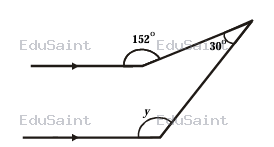
The angles on a straight line are supplementary. $y + 28 = 180 \Rightarrow y = 152^\circ$.
JAMB (UTME)
Mathematics
1991
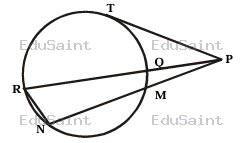
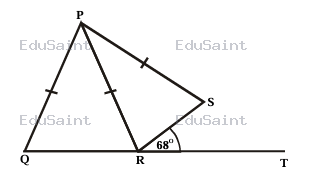
Q10498.In the figure above, PQ = PR = PS and SRT = $68^\circ$. Find QPS.
A\(136^\circ\)
B\(124^\circ\)
C\(112^\circ\)
D\(68^\circ\)
Correct Answer: A
Since PQ=PR=PS, P is the centre of the circle through Q, R, S. $\angle QPS = 2 \times \angle QRS = 2 \times 68 = 136^\circ$.
JAMB (UTME)
Mathematics
1991
Q10499.A flagstaff stands on the top of a vertical tower. A man standing 60m away from the tower observes that the angles of elevation of the top and bottom of the flagstaff are \(64^\circ\) and \(62^\circ\) respectively. Find the length of a flagstaff.
A\(60(\tan 62^\circ - \tan 64^\circ)\)
B\(60(\cot 64^\circ - \cot 62^\circ)\)
C\(60(\cot 62^\circ - \cot 64^\circ)\)
D\(60(\tan 64^\circ - \tan 62^\circ)\)
Correct Answer: D
Height of flagstaff = Height of top - Height of bottom = $60 \tan 64^\circ - 60 \tan 62^\circ = 60(\tan 64^\circ - \tan 62^\circ)$.